 Mathieu Benoit
a2d3aa2a78
Mathieu Benoit
a2d3aa2a78
Added 30 .base.md files using the mmg (Multilingual Markdown Generator)
format to automatically generate English (.md) and French (.fr.md)
versions of all project documentation.
Updated conf/make.documentation.Makefile to process all .base.md files
via `make doc_markdown`.
10 KiB
Windows 10 version 2004 and up or 11 - release and development
A guide on how to set up a workspace and run ERPLibre on Windows 10 version 2004 and up or Windows 11. There are two methods of installation, one is automatic and the other manual.
"WSL2 Ubuntu 22.04" will be referred as "WSL2"
"PyCharm Professional" will be referred as "PyCharm"
Install WSL2
Run Powershell with administrator rights and run the following command:
wsl --install -d Ubuntu-22.04
If you have trouble opening the Powershell with administrator rights, press Windows + R, enter the following line and press OK. You will be automatically prompted for administrator rights.
powershell.exe
Troubleshooting - Optional
If you have issues enable virtualization options in BIOS is available (hyper-v, vt-x, etc). Search for Turn Windows features on or off in the Windows search bar and ensure that Windows Subsystem for Linux is turned on before restarting your machine.
You can also try theses powershell commands:
dism.exe /online /enable-feature /featurename:VirtualMachinePlatform /all /norestart
wsl --set-default-version 2
Download and install the lastest Linux kernel update package from Microsoft with the following link:
https://wslstorestorage.blob.core.windows.net/wslblob/wsl_update_x64.msi
Only run this command as your last resort as it can break other virtual machines:
bcdedit /set hypervisorlaunchtype auto
Other Installation methods for WSL2
Run Powershell with administrator rights and run the following command:
curl.exe -L -o ubuntu-2004.appx https://aka.ms/wslubuntu2004
Run Powershell with administrator rights and run the following commands:
Invoke-WebRequest -Uri https://aka.ms/wslubuntu2004 -OutFile Ubuntu.appx -UseBasicParsing
Add-AppxPackage .\Ubuntu.appx
Install WSL2 from the Microsoft Store with the following link:
https://apps.microsoft.com/store/detail/ubuntu-22041-lts/9PN20MSR04DW
Setup WSL2 for ERPLibre
Once WSL2 has been installed correctly, reboot your computer.
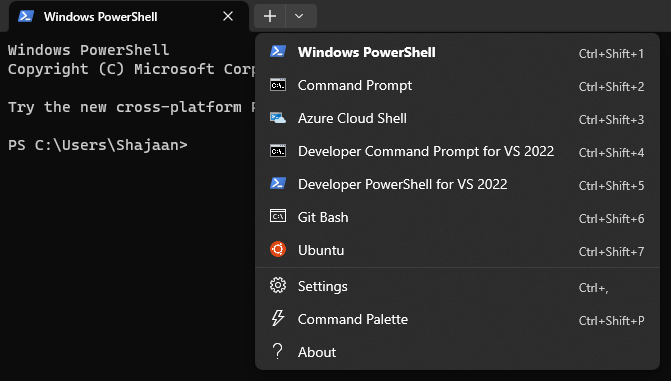
You can open your Ubuntu many ways:
- Search "Ubuntu" by clicking the Windows key
- Download the Windows Terminal from the Microsoft Store
If you are using the Windows Terminal, you just have to click the little arrow next to the + sign and then you will see Ubuntu.
Setup a GUI for you Ubuntu
- Update your Ubuntu
sudo apt-get update -y && sudo apt-get upgrade -y
- Install the XFCE4 Desktop
sudo apt install -y xrdp xfce4 xfce4-goodies
- Setup the Desktop
sudo cp /etc/xrdp/xrdp.ini /etc/xrdp/xrdp.ini.bak
sudo sed -i 's/3389/3390/g' /etc/xrdp/xrdp.ini
sudo sed -i 's/max_bpp=32/#max_bpp=32\nmax_bpp=128/g' /etc/xrdp/xrdp.ini
sudo sed -i 's/xserverbpp=24/#xserverbpp=24\nxserverbpp=128/g' /etc/xrdp/xrdp.ini
echo xfce4-session > ~/.xsession
- Setup the Remote Desktop Connection
sudo nano /etc/xrdp/startwm.sh
Comment these lines with a #
test -x /etc/X11/Xsession && exec /etc/X11/Xsession
exec /bin/sh /etc/X11/Xsession
Add this line at the end of the file
startxfce4
Exit with Ctrl+S, Ctrl+X
- Starting Ubuntu Desktop GUI
Open Ubuntu Terminal on your Windows and enter this command
sudo /etc/init.d/xrdp start
Then open Remote Desktop Connection by clicking the Windows key and connect to localhost:3390
Memory - Optional
If WSL is taking too much memory, you can reduce with an easy step. You just have to go to C:\Users\YourUsername.wslconfig and create a .wslconfig file and write:
sudo /etc/init.d/xrdp start

[wsl2]
memory=3GB
Installation of the necessary and up-to-date tools
sudo apt update
sudo apt install build-essential zlib1g-dev libncurses5-dev libgdbm-dev libnss3-dev libssl-dev libsqlite3-dev libreadline-dev libffi-dev curl libbz2-dev rsync make git
Installation of ERPLibre under WSL2
Make sure to be in the directory where you want to clone the project.
git clone https://github.com/ERPLibre/ERPLibre.git
cd ERPLibre
make install
Add role to PostgresSQL, change USERNAME field in the command with your UNIX username from your WSL2 environment.
sudo service postgresql start
sudo su - postgres -c "createuser -s USERNAME" 2>/dev/null || true
Common Problems During Installation
Error During make install
Ensure all dependencies are installed correctly. Re-run the following command to fix any broken dependencies:
sudo apt-get install -f
PostgreSQL Not Starting
Check the PostgreSQL service status with the following command:
sudo service postgresql status
If PostgreSQL is not running, try restarting it with:
sudo service postgresql restart
Running ERPLibre
Everytime you restart your machine, the following command has to be executed to start the PostgreSQL service if it is not already running:
sudo service postgresql start
After that run this command in the root of the project:
./run.sh
Verifying ERPLibre
While ERPLibre is running, make sure that you can connect to the following URL http://localhost:8069 and have the ability to create, modify and remove databases.
Set up Development Environment - PyCharm
Install PyCharm
Install PyCharm from the following link:
https://www.jetbrains.com/pycharm/download/#section=windows
Set up Pycharm
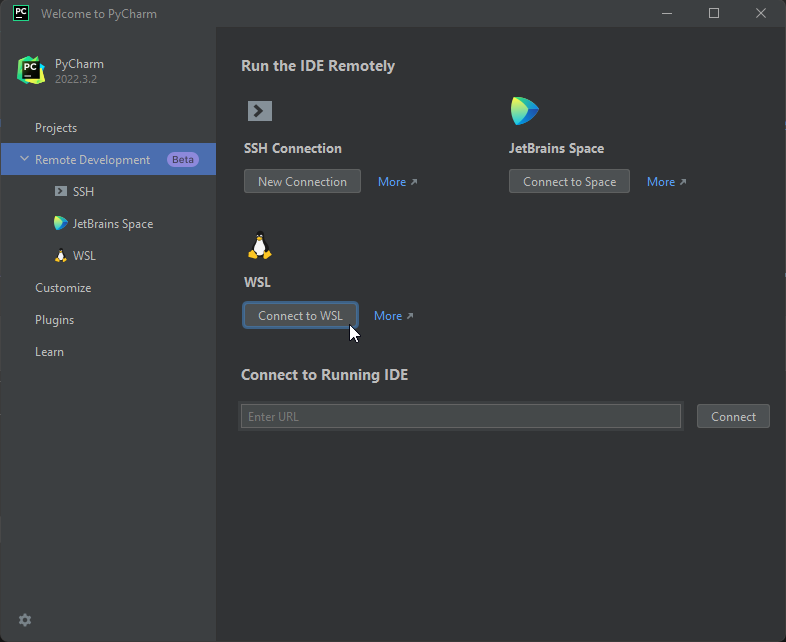
Select Connect to WSL under Remote Development. After that select your Ubuntu instace ("Ubuntu-22.04"). Point Project directory to the root of the project. Once everything has been selected and filled out correctly, click on Start IDE and Connect.
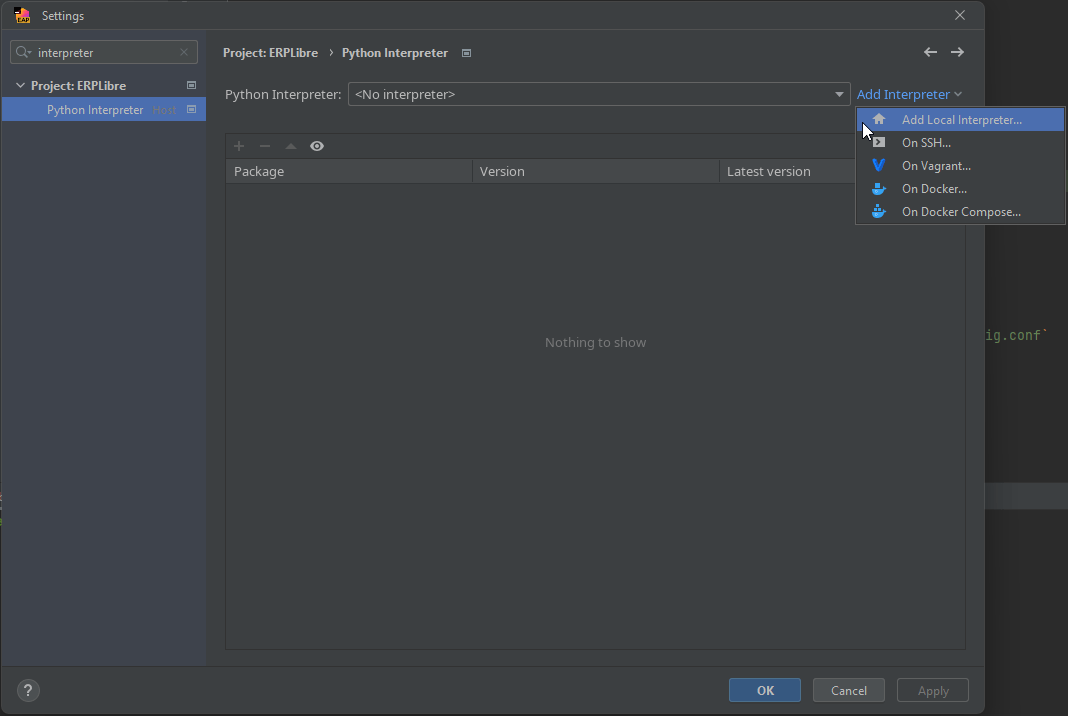
Press CTRL+ALT+S, search for interpreter and inside the Python Interpreter page, click on Add Interpreter and select Add Local Interpreter....
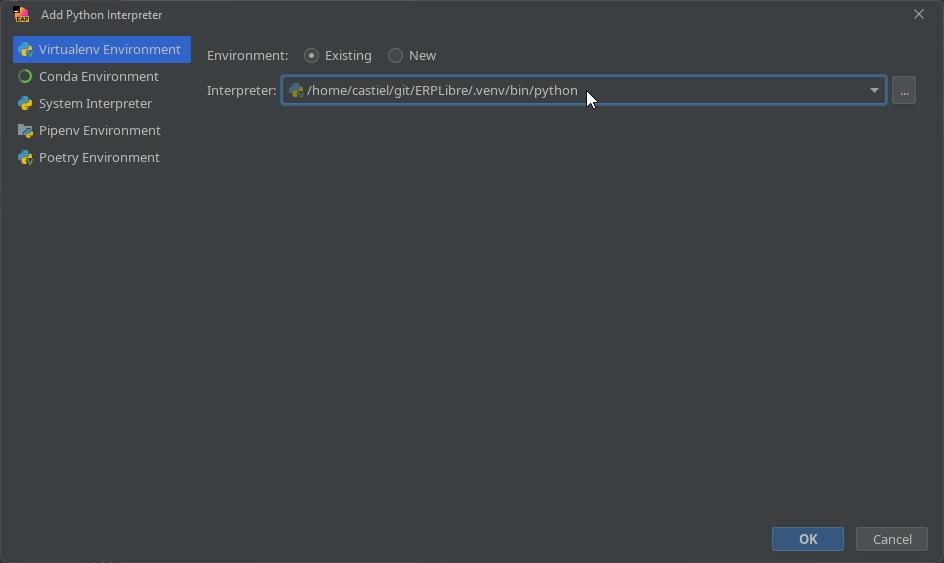
Make sure to select Virtualenv Environment on the left and the Existing radio button. Once theses are both selected properly, point your interpreter to the ../ERPLibre/.venv/bin/python directory of the project and click on OK.
If these last steps to set up your development environment were unsuccessful, follow the next "Manual" steps to set up your environment.
Manual Installation
Install Python 3.10.14
You can delete the files that are left over in your home directory regarding the python installation when the steps have been completed succesfully.
cd ~
wget https://www.python.org/ftp/python/3.10.14/Python-3.10.14.tgz
tar -xzf Python-3.10.14.tgz
cd Python-3.10.14
./configure --enable-optimizations
make -j $(nproc)
sudo make install
Verify the installation
python3.10
Set Python 3.10.14 as default
alias python='/usr/local/bin/python3.10'
source ~/.bashrc
Set up Pycharm
Open the project directory in PyCharm.
Press CTRL+ALT+S, search for interpreter and inside the Python Interpreter page, click on Add Interpreter and select On WSL....
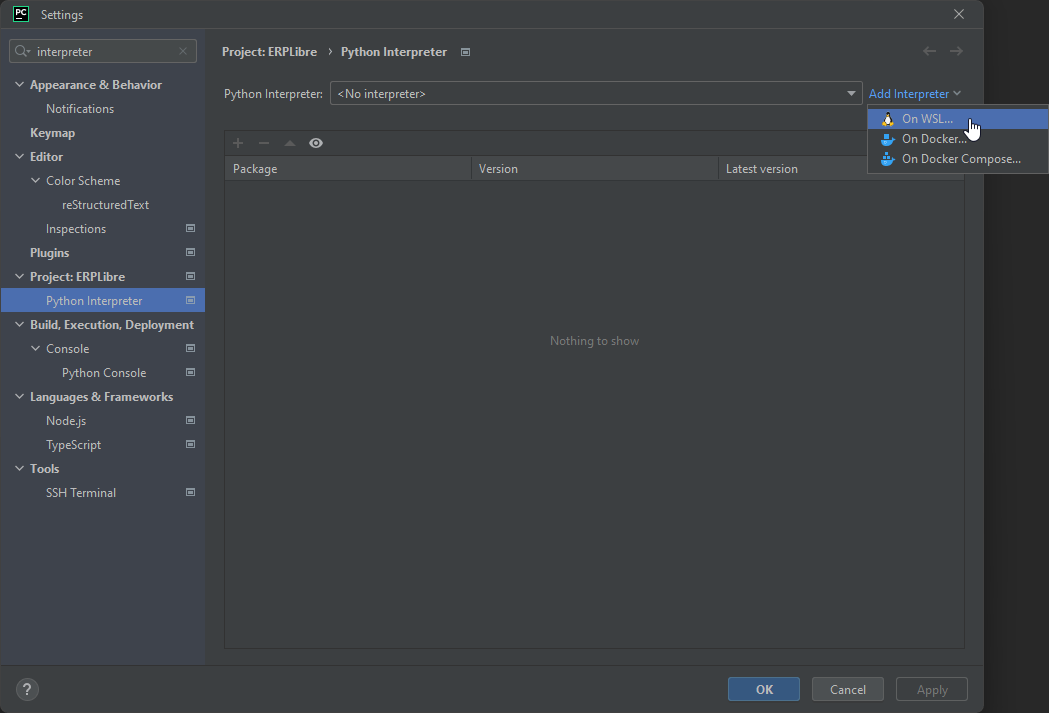
Wait until PyCharm detects your WSL2 instance and press NEXT. Click on System Interpreter on the left, select the correct interpreter if it hasn't done so automatically and click Create.
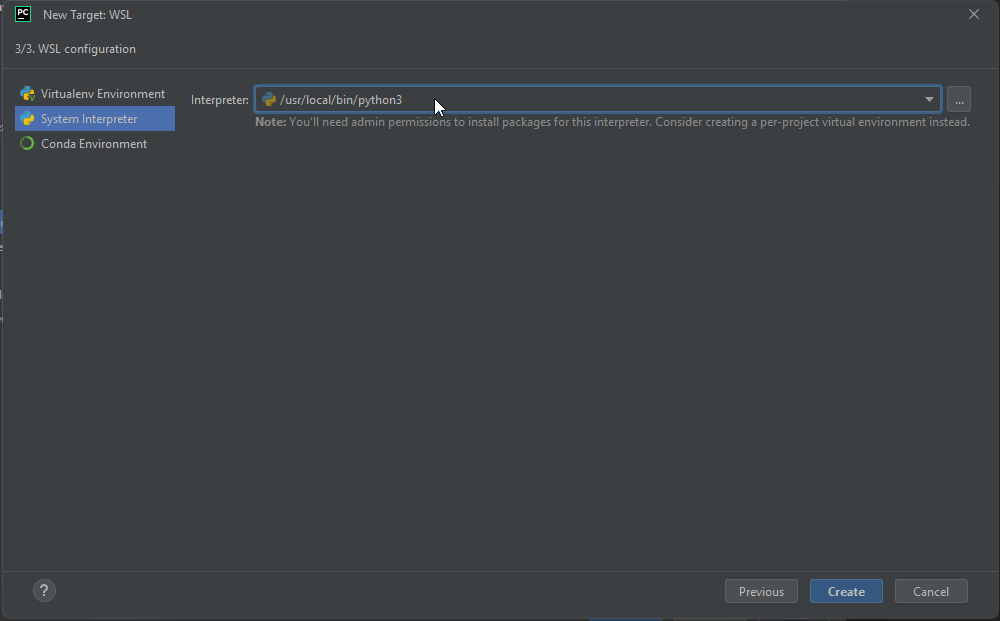
Close the project's settings. Once PyCharm prompts you to import modules and allow it.
Common problems with Windows Development
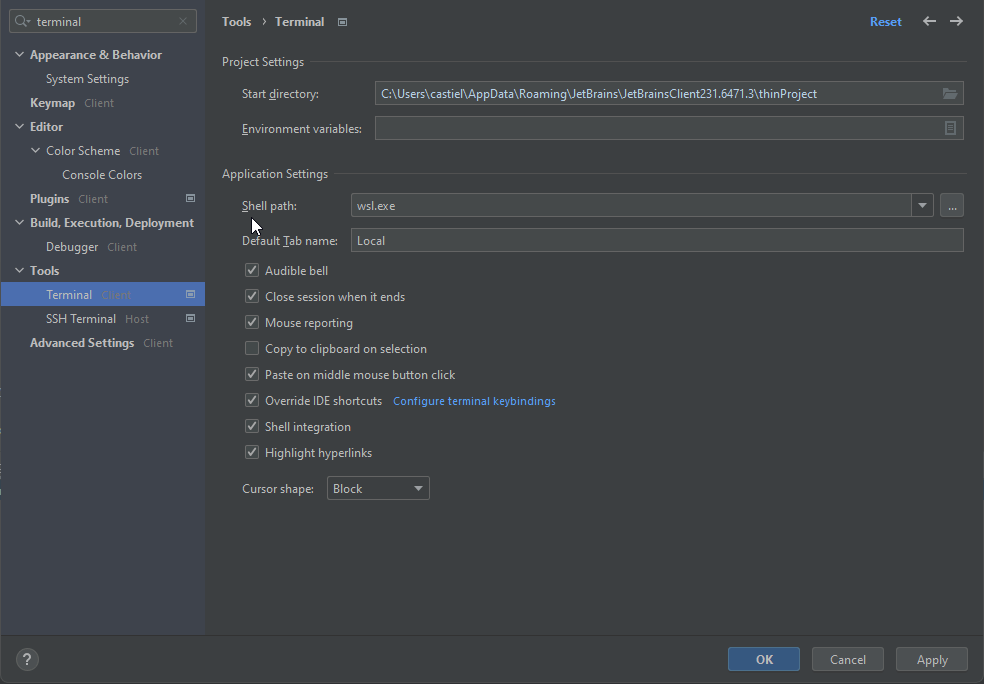
Broken Terminal
Search for terminal in the settings, and under Application Settings in the Shell path: field enter the following line:
wsl.exe
High Memory Usage warnings
If you experience high memory usage, click on Help in the toolbar and choose Change Memory Settings to increase the memory heap of the IDE.
Missing or incorrect imported modules
PyCharm might not fully recognize some details from requirements.txt and pyproject.toml (e.g., specific module versions). If you encounter issues at runtime or while debugging, search for the correct version of the module and reinstall it using PyCharm's package manager.
Can't run ERPLibre from PyCharm
If ERPLibre fails to run from PyCharm, execute the following command in the root directory of the project from the terminal in PyCharm or WSL2:
./script/ide/pycharm_configuration.py
Can't restart ERPLibre
Run htop from the terminal in PyCharm or WSL2 and close the python processes related to ERPLibre to release the socket.
References
WSL Installation Comprehensive guide on installing Windows Subsystem for Linux (WSL) on Windows.
PostgreSQL Official Documentation Official PostgreSQL documentation for troubleshooting common issues and learning more about PostgreSQL commands and configuration.
PyCharm Installation and Configuration Quick start guide for setting up and configuring PyCharm, including handling Python modules and environment setup.
WSL Troubleshooting Troubleshooting guide for common issues encountered in WSL, providing solutions for various problems that may arise.
Linux GUI Instructions for setting up a graphical user interface (GUI) in WSL, which might be helpful for better integration of Linux applications.
Memory Problem Guide on how to manage and limit memory usage in WSL 2 to avoid high memory consumption issues.