* Fix account_tests

* Fix hook executable test

* Remove the temporary decorator @broken_on_windows

* Fix util_test

* No broken unit test on Windows anymore

* More elegant mock

* Fix context manager

* Fix lint

* Fix mypy

* Adapt coverage

* Corrections

* Fix lint

* Adapt coverage

* Update certbot/tests/compat/filesystem_test.py

Co-Authored-By: Brad Warren <bmw@users.noreply.github.com>

* Update util_test.py

* Fix pylint

* Forbid os.access

* Update os_test.py

* Update os.py

* Fix lint

* Update filesystem.py

* Update filesystem.py

* Update filesystem.py

* Update os.py

* Start fixing tests

* Platform independent hooks

* Fix probe fd close

* Add broken_on_windows for integration tests

* Fix a lot of tests

* Use a python hook script, to prepare cross-platform

* New approach to be compliant with Linux and Windows on hook scripts

* New tests fixed

* Test for permissions on Windows

* Permissions comparison for Windows

* No broken tests in certbot core anymore

* Change mode

* Specific config for appveyor

* Use forked pebble for now

* Various fixes

* Assert file permissions for world on private keys

* Clean code

* Fix several things

* Add integration target

* Optimize integration env

* Re-enable all AppVeyor envs

* Use again official pebble

* Update pebble_artifacts.py

* Set PYTEST_ADDOPTS silently

* Update appveyor.yml

* Pin pywin32 for tests, give a minimal requirement for certbot.

* Remove injection of nginx in PATH

* Clean debug code

* Various cleanup, ensure to remove workspace after tests

* Update tox target

* Improve assertions. Control the keyword echoed in hooks

* Fix for virtualenv on Python 3.7.4 for Windows

* Update certbot-ci/certbot_integration_tests/certbot_tests/assertions.py

Co-Authored-By: Brad Warren <bmw@users.noreply.github.com>

* Add conditionally pywin in certbot-ci like in certbot
We're planning on using the branch apache-parser-v2 allowing us to incrementally work on the new Apache parser and feel comfortable landing temporary test code that we don't really want in master.

The apache-parser-v2 branch is created and locked down, but neither Travis or AppVeyor are configured to run tests on it. See #7230. This PR fixes that problem.

This could probably just land in the apache-parser-v2 branch, but why unnecessarily deviate the branch from master? It doesn't hurt anything there. Once it lands, I'll get this added to the apache-parser-v2 branch too.

* Run tests on apache-parser-v2.

* add comment

* Don't run full test suite on apache-parser-v2.
* Update virtualenv to the latest version.

* Use venv from pip and pin more packages.

* Pin codecov.

* update appveyor config

* Write the path separator backwards.

* s/pip_install.py install/pip_install.py

* Prefix tools\\pip_install.py with python exe.

* Upgrade py to fix AppVeyor failures.

* add back comment

* Update virtualenv with CERTBOT_NO_PIN.

* Pass -U to upgrade tox and deps.

* Upgrade virtualenv.
So, we observed lately several inconsistencies in how Codecov behave toward the CI pipeline for PRs in Certbot. One example is #6888. The most annoying thing is that the build of PR is **temporary** marked as failed, until all coverage are run.
The correction on the latter is done in two PRs. This is the first part.
TL;DR
This PR separates the Codecov report in two: one for coverage executed on Windows, one for Linux. This is the correct way to do regarding our current CI pipeline. Actions are required by a GitHub administrator of Certbot once this PR is merged.
Complete explanation
So the failure stated in the introduction is essentially due to several things interacting together:
* AppVeyor generates a coverage report for Windows, that have a coverage value a little lower than on Linux (96%)
* Travis generates a coverage report for Linux. Its coverage is higher, and slowly decrease as more specific Windows code is added to Certbot, that cannot be tested on Travis
* Since AppVeyor saw its capacity increasing, it finishes its coverage job before the one from Travis
* Certbot GitHub repo is configured to require the coverage pipeline to succeed (in whatever that means) to success the overall PR build
So here the suite of events:
1) PR is issued. GitHub expect three pipeline to succeed: AppVeyor CI, Travis CI and Codecov (displayed in the PR page)
2) Codecov receive first the report of AppVeyor coverage. It is 96%. It is a failure for now, because coverage in master (AppVeyor+Travis) is 98.6%.
3) GitHub is reported of the failure on Codecov, so fail the PR build
4) Codecov receive then the report of Travis coverage. It is 98%. It merges it with the report from AppVeyor, leading to the 98.6%. The failure becomes a success.
5) GitHub is reported of the success on Codecov, so, nevermind, the PR build is a success finally!
So we have a CI flow that change its mind. Great. This is because of 2) and 4), and we could expect that Codecov should handle that. This is not the case: it is somewhat misleading, because Codecov adverts a lot about its capability to merge reports, including from different CI. But it is about the final state, not about the transient state, while reports are progressively received.
Two things to things that a transient state is existing, with a result that can change:
* first, from Codecov doc itself, explaining that reports should not be trusted during the CI pipeline execution: https://docs.codecov.io/docs/ci-service-relationship#section-checking-ci-status
* second, is an example of transient state of `cryptography` project, this is advert by Codecov to be a reference of the implementation:
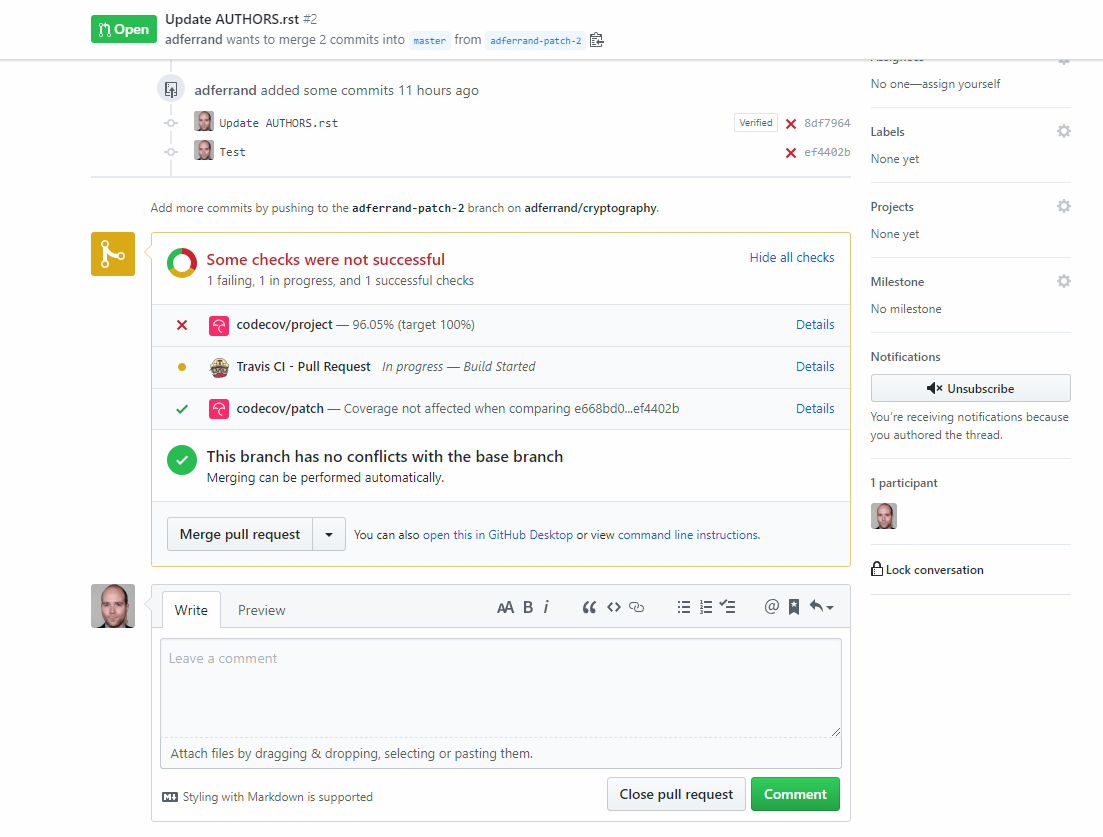
As you can see above, build state of `cryptography` is failing after the first report is received, and until all coverage reports from Travis are received.
So, what can we do about it? Thing is, we are aggregating coverage from very two unrelated sources (two different OS systems), and Codecov has something for that. This is flags: https://docs.codecov.io/docs/flags
Flags allow to flag coverage material depending on any logic you apply to the command that uploaded the coverage report (eg. `codecov -F a_flag`). Then, several logics can be applied on it, for instance having in Codecov UI the capability to filter the coverage other a flag, having status of build for each flag and ... having a report for a specific flag.
So:
1) I modified Travis and AppVeyor to send their report under a specific flag: `linux` or `windows`
2) I created a project specific `.codecov.yml` configuration in Certbot repository, to instruct Codecov to push two separate reports on GitHub build: one for Linux, one for Windows. Each report can be validated against its specific coverage from the `master` branch (more on this just after)
With all of this, now the GitHub is succeeding, because each coverage is validated independently.
I think it is the good approach, because it solves the specific issue here, and because it reflects the logic behind: merging coverage from different OS architectures does not make much sense. It would be a long-term problem, because as I said at the beginning, coverages will slowly decrease as more platform specific code is added in Certbot.
Now, it is not finished. Two things need to be done: an administrator action, and a second PR
Administrator action
Certbot GitHub as a a branch protection rule (Settings > Branches > Branch protection rules). It needs to be changed.
Indeed this rule is expecting the full coverage report (named `codecov/project`) to be valid on a PR. It needs to be changed to expect two coverage reports: `codecov/project/linux` and `codecov/project/windows`. The `codecov/project` needs to be removed.
This can be done once this PR is merged, and the specific coverage reports have been generated on master.
Second PR
Once this PR is merged and administrative actions have been done. I will make a new PR modifying `.codecov.yml` with two things:
* disable the faulty full coverage report, that is not required anymore by GitHub branch protection rules
* modify the `linux` and `windows` reports to validate against the relevant coverage calculated from `master` (indeed, in this PR it is a fixed ratio rule, since the coverage to compare on master is the full coverage one, significantly higher)
* Tag reports
* Set per-project codecov configuration
By removing all the builds on push to master, done in #6804, we also removing the coveralls reports that are necessary to calculate the effect of a PR on code coverage, that is part of the quality gate process.

This PR is reverting #6804, and another implementation preserving the coveralls reports will be done soon.

This reverts commit a468a3b255.
Fixes#6746.
Every commit on master is always the result of a merged PR, that has been tested by Travis. So retesting the merge commit on master is superfluous. This PR uses build conditions to avoid to launch a build for a commit push on master.
I also added the equivalent logic for AppVeyor. Builds cannot received conditions, so it needs to be done on init using Exit-AppVeyorBuild. This command does not fail the build, it finishes it prematurely with success.
* Disable build for commit pushed on master (PR are still tested of course)
* Equivalent exclusion code for AppVeyor
PR #6568 removed the --quiet option in pip invocations, because this option deletes a lot of extremely useful logs when something goes wrong. However, when everything goes right, or at least when pip install is correctly executed, theses logs add hundreds of lines that are only noise, making hard to debug errors that can be in only one or two lines.

We can have best of both worlds. Travis allows to fold large blocks of logs, that can be expanded directly from the UI if needed. It only requires to print in the console some specific code, that this PR implements in the pip_install.py script when the build is run in Travis (known by the existence of TRAVIS environment variable).

I also take the occasion to clean up a little tox.ini.

Note that AppVeyor does not have this fold capability, but it can be emulated using a proper capture of stdout/stderr delivered only when an error is detected.

* Fold pip install log on travis

* Global test env

* Export env variable
Certbot relies heavily on bash scripts to deploy a development environment and to execute tests. This is fine for Linux systems, including Travis, but problematic for Windows machines.

This PR converts all theses scripts into Python, to make them platform independant.

As a consequence, tox-win.ini is not needed anymore, and tox can be run indifferently on Windows or on Linux using a common tox.ini. AppVeyor is updated accordingly to execute tests for acme, certbot and all dns plugins. Other tests are not executed as they are for Docker, unsupported Apache/Nginx/Postfix plugins (for now) or not relevant for Windows (explicit Linux distribution tests or pylint).

Another PR will be done on certbot website to update how a dev environment can be set up.

* Replace several shell scripts by python equivalent.

* Correction on tox coverage

* Extend usage of new python scripts

* Various corrections

* Replace venv construction bash scripts by python equivalents

* Update tox.ini

* Unicode lines to compare files

* Put modifications on letsencrypt-auto-source instead of generated scripts

* Add executable permissions for Linux.

* Merge tox win tests into main tox

* Skip lock_test on Windows

* Correct appveyor config

* Update appveyor.yml

* Explicit coverage py27 or py37

* Avoid to cover non supported certbot plugins on Windows

* Update tox.ini

* Remove specific warnings during CI

* No cover on a debug code for tests only.

* Update documentation and help script on venv/venv3.py

* Customize help message for Windows

* Quote correctly executable path with potential spaces in it.

* Copy pipstrap from upstream
So here we are: after #6361 has been merged, time is to provide an environment to execute the automated testing on Windows.

Here are the assertions used to build the CI on Windows:

every test running on Linux should ultimately be runnable on Windows, in a cross-platform compatible manner (there is one or two exception, when a test does not have any meaning for Windows),
currently some tests are not runnable on Windows: theses tests are ignored by default when the environment is Windows using a custom decorator: @broken_on_windows,
test environment should have functionalities similar to Travis, in particular an execution test matrix against various versions of Python and Windows,
so test execution is done through AppVeyor, as it supports the requirements: it add a CI step along Travis and Codecov for each PR, all of this ensuring that Certbot is entirely functional on both Linux and Windows,
code in tests can be changed, but code in Certbot should be changed as little as possible, to avoid regression risks.
So far in this PR, I focused on the tests on Certbot core and ACME library. Concerning the plugins, it will be done later, for plugins which have an interest on Windows. Test are executed against Python 3.4, 3.5, 3.6 and 3.7, for Windows Server 2012 R2 and Windows Server 2016.

I succeeded at making 258/259 of acme tests to work, and 828/868 of certbot core tests to work. Most of the errors where not because of Certbot itself, but because of how the tests are written. After redesigning some test utilitaries, and things like file path handling, or CRLF/LF, a lot of the errors vanished.

I needed also to ignore a lot of IO errors typically occurring when a tearDown test process tries to delete a file before it has been closed: this kind of behavior is acceptable for Linux, but not for Windows. As a consequence, and until the tearDown process is improved, a lot of temporary files are not cleared on Windows after a test campaign.

Remaining broken tests requires a more subtile approach to solve the errors, I will correct them progressively in future PR.

Last words about tox. I did not used the existing tox.ini for now. It is just to far from what is supported on Windows: lot of bash scripts that should be rewritten completely, and that contain test logic not ready/relevant for Windows (plugin tests, Docker compilation/test, GNU distribution versatility handling and so on). So I use an independent file tox-win.ini for now, with the goal to merge it ultimately with the existing logic.

* Define a tox configuration for windows, to execute tests against Python 3.4, 3.5, 3.6 and 3.7 + code coverage on Codecov.io

* Correct windows compatibility on certbot codebase

* Correct windows compatibility on certbot display functionalities

* Correct windows compatibility on certbot plugins

* Correct test utils to run tests on windows. Add decorator to skip (permanently) or mark broken (temporarily) tests on windows

* Correct tests on certbot core to run them both on windows and linux. Mark some of them as broken on windows for now.

* Lock tests are completely skipped on windows. Planned to be replace in next PR.

* Correct tests on certbot display to run them both on windows and linux. Mark some of them as broken on windows for now.

* Correct test utils for acme on windows. Add decorator to skip (permanently) or mark broken (temporarily) tests on windows.

* Correct acme tests to run them both on windows and linux. Allow a reduction of code coverage of 1% on acme code base.

* Create AppVeyor CI for Certbot on Windows, to run the test matrix (py34,35,36,37+coverage) on Windows Server 2012 R2 and Windows Server 2016.

* Update changelog with Windows compatibility of Certbot.

* Corrections about tox, pyreadline and CI logic

* Correct english

* Some corrections for acme

* Newlines corrections

* Remove changelog

* Use os.devnull instead of /dev/null to be used on Windows

* Uid is a always a number now.

* Correct linting

* PR https://github.com/python/typeshed/pull/2136 has been merge to third-party upstream 6 months ago, so code patch can be removed.

* And so acme coverage should be 100% again.

* More compatible tests Windows+Linux

* Use stable line separator

* Remove unused import

* Do not rely on pytest in certbot tests

* Use json.dumps to another json embedding weird characters

* Change comment

* Add import

* Test rolling builds #1

* Test rolling builds #2

* Correction on json serialization

* It seems that rolling builds are not canceling jobs on PR. Revert back to fail fast code in the pipeline.


