 Mathieu Benoit
dfd6cd1fb6
Mathieu Benoit
dfd6cd1fb6
[ADD] commentaires : la convention, ses deux garde-fous, le code nettoyé Six commits. Le dépôt n'avait aucune règle sur le commentaire de code : le seul modèle d'écriture disponible était celui du corps de commit, et le gabarit y renvoyait explicitement le raisonnement qui n'y tenait pas. Le récit s'est donc écoulé dans les sources, avec les noms qu'il portait. L'épreuve tient en une phrase : le code est le sujet, au présent de ce qu'il fait. Une phrase dont le sujet est un incident, une machine, une date ou une personne part vers tasks/, qui n'est pas versionné ; le mode de défaillance que le code empêche, lui, reste. Rien d'identifiant hors de private/, et l'exemple qui illustre cet interdit s'invente plutôt qu'il ne s'emprunte, un test figeant pour toujours ce qu'il contient. Deux garde-fous, de sévérité opposée. Le hook commit-msg REFUSE la part mécanique d'un message : longueur par langue, adresse, courriel, chemin de compte. Le hook pre-commit INFORME — il liste les commentaires à relire dans les fichiers indexés et sort toujours en 0, un contrôle bloquant à cette échelle se faisant désinstaller. L'outil sépare la trouvaille du signal : l'identifiant se retire, le récit se relit, la même phrase pouvant énoncer un fait durable. Un écran du menu TODO relève le contexte fourni à un assistant sur ses six sources et repère une commande déployée qui a dérivé de son gabarit. Code et jeux d'essai perdent au passage leurs valeurs réelles — base, adresse, compte, hôte — au profit de valeurs inventées. Vérifié : 65 tests neufs, dont 43 pour l'outil seul. Le prédicat qui distingue une adresse d'une version de manifeste est partagé par les deux garde-fous, deux prédicats pour une même question finissant par diverger. --- EN --- Six commits. The repository had no rule at all about code comments: the only writing model available was the commit body, and the template explicitly sent the reasoning that did not fit there into a code comment. The story therefore flowed into the sources, carrying the names it named. The test fits in one sentence: the code is the subject, in the present of what it does. A sentence whose subject is an incident, a machine, a date or a person goes to tasks/, which is not versioned; the failure mode the code prevents stays. Nothing identifying outside private/, and the example illustrating that ban is invented rather than borrowed, a test freezing forever what it holds. Two guard rails, of opposite severity. The commit-msg hook REFUSES what is mechanical in a message: length per language, address, e-mail, account path. The pre-commit hook INFORMS — it lists the comments worth re-reading in the staged files and always exits 0, a blocking check at that scale getting uninstalled. The tool separates the finding from the signal: identifying data is removed, narrative is re-read, the same sentence being able to state a durable fact. A TODO screen reports the context given to an assistant across its six sources and spots a deployed command that drifted from its template. Code and fixtures lose their real values along the way — database, address, account, host — for invented ones. Checked: 65 new tests, 43 of them for the tool alone. The predicate telling an address from a manifest version is shared by both guard rails, two predicates for one question ending up diverging. Assisted-by: Claude Opus 5 |
||
|---|---|---|
| .claude | ||
| .github | ||
| conf | ||
| contracts | ||
| doc | ||
| docker | ||
| long_test | ||
| manifest | ||
| mobile | ||
| private | ||
| requirement | ||
| script | ||
| test | ||
| .editorconfig | ||
| .erplibre-semver-version | ||
| .flake8 | ||
| .gitignore | ||
| .prettierignore | ||
| AI_POLICY.base.md | ||
| AI_POLICY.fr.md | ||
| AI_POLICY.md | ||
| CHANGELOG.base.md | ||
| CHANGELOG.fr.md | ||
| CHANGELOG.md | ||
| CLAUDE.md | ||
| coverage_run.sh | ||
| docker-compose-dev.yml | ||
| docker-compose.yml | ||
| env_var.sh | ||
| install.sh | ||
| LICENSE | ||
| Makefile | ||
| odoo_bin.sh | ||
| package-lock.json | ||
| package.json | ||
| poetry.toml | ||
| README.base.md | ||
| README.fr.md | ||
| README.md | ||
| run.sh | ||
| source_repo_addons.csv | ||
| test.sh | ||
| TODO.base.md | ||
| TODO.fr.md | ||
| TODO.md | ||
ERPLibre
ERPLibre is a CRM/ERP platform including automated installation, maintenance, and development of open source modules of the Odoo community version. It is a "soft-fork" of the Odoo Community Edition (OCE), meaning it aims at contributing back upstream. It is based on a set of production-ready modules, supported by the Odoo Community Association (OCA) and an ecosystem of specialized companies. This solution ensures digital sovereignty in a local environment while integrating pre-trained Generative Transformers (GPT), bringing an additional dimension to data management and automation.
Follow us on Mastodon : https://fosstodon.org/@erplibre
Features
- Multi-version Odoo support : run Odoo 12.0, 13.0, 14.0, 15.0, 16.0, 17.0 and 18.0 in the same workspace, with independent Python virtual environments (
.venv.erplibreand.venv.odooXX) - Interactive CLI (TODO.py) : guided interactive tool for installation, execution, database management, code formatting, mobile compilation, and more. Launch it with
make - Code generator : generate Odoo modules automatically with support for views, portal, snippets, inheritance, i18n, and JavaScript
- Selenium automation : web testing and automation with Selenium Grid, video recording, and login automation
- Mobile application : ERPLibre Home Mobile (Owl + Capacitor), compiled and deployed via TODO.py
- Docker deployment : production-ready Docker images with PostgreSQL 18 and PostGIS
- Deployment tools : Nginx, Apache, Cloudflare DDNS, Certbot SSL, systemd services
- Database tools : backup, restore, clone, migration between versions, production-to-dev migration
- Performance tools : request-per-second measurement, parallel test execution, coverage analysis
Supported Odoo versions
| Odoo version | Python | Status |
|---|---|---|
| 18.0 | 3.12.10 | Active |
| 17.0 | 3.10.18 | Inactive |
| 16.0 | 3.10.18 | Inactive |
| 15.0 | 3.8.20 | Deprecated |
| 14.0 | 3.8.20 | Deprecated |
| 13.0 | 3.7.17 | Deprecated |
| 12.0 | 3.7.17 | Deprecated |
Switch between versions with make switch_odoo_18, make switch_odoo_16, etc.
Supported platforms
- Ubuntu : 24.04, 25.10, 26.04 — 20.04 and 22.04 are dropped, pikepdf requiring a qpdf 12.2 built in C++20
- Linux Mint : 22.3
- Debian : 12 (bookworm) and 13 (trixie)
- Fedora : 41 and later
- AlmaLinux, Rocky Linux : 9 and 10 — RHEL and CentOS Stream take the same path
- openSUSE : Leap 16.0 and Tumbleweed
- Arch Linux : rolling release
- macOS : through mise or pyenv
- Windows : through WSL or Docker
- Architectures : amd64, arm64 and s390x (IBM Z mainframe)
Installation in production
Easy installation on Ubuntu or Debian using Docker
This has been tested in Debian 12 and Ubuntu 24.04 LTS.
Note : This is meant for a test environment, on a local network or similar environment not directly exposed to the Internet.
-
Make sure Docker and nginx web server are installed:
sudo apt install docker.io docker-compose-v2 nginx -
Get the latest ERPLibre Docker compose file:
wget https://raw.githubusercontent.com/ERPLibre/ERPLibre/master/docker-compose.yml -
Install and run ERPLibre with Docker running as a daemon (web server):
sudo docker compose up -d -
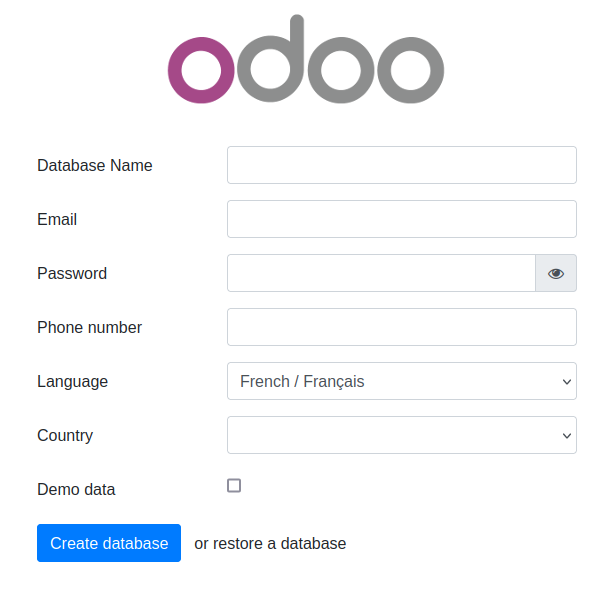
Open the final installation step at this web page :
http://[server IP]:8069/web/database/manager
-
Finish the installation by providing a database name, email and password. then click on Create Database. Depending on your system resources this may take more than 2 minutes without feedback ! Check your browser loading indicator.
-
Next, the web page will reload itself, and you should see the Applications list in ERPLibre:
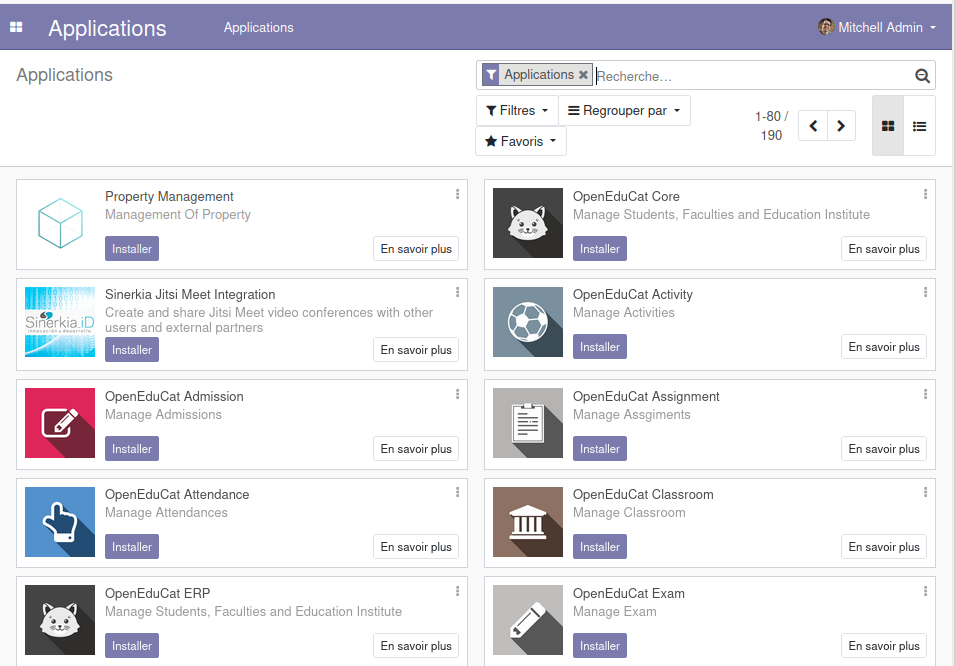
You can now personalize your ERPLibre installation.
For more information, read Docker guide.
Install from source code
Automated installation
For Debian/Ubuntu
sudo apt install make python3
Clone the project:
git clone https://github.com/ERPLibre/ERPLibre.git
cd ERPLibre
Follow the instruction on the following script, it will try to detect your environment.
make
Manually
Into Ubuntu, minimal dependency:
sudo apt install make git curl
Into Ubuntu, developer dependency:
sudo apt install make build-essential libssl-dev zlib1g-dev libreadline-dev libsqlite3-dev curl llvm libncurses5-dev libncursesw5-dev xz-utils tk-dev liblzma-dev libbz2-dev libldap2-dev libsasl2-dev
Clone the project:
git clone https://github.com/ERPLibre/ERPLibre.git
cd ERPLibre
make install_os detects the distribution and picks the right dependency script: apt for Ubuntu, Linux Mint and Debian, dnf for Fedora and the RHEL family, zypper for openSUSE, pacman for Arch. See the supported platforms above.
make install_os
make install_odoo_18
Install a specific Odoo version:
make install_odoo_16
make install_odoo_17
make install_odoo_18
Update your configuration if you need to run from another interface than 127.0.0.1, file config.conf
xmlrpc_interface = 0.0.0.0
Show version :
make version
Ready to execute:
make run
Test
Execute ERPLibre test with his code generator.
time make test_full_fast
Documentation
| Guide | Description |
|---|---|
| DISCOVER | Learn and explore ERPLibre |
| DEVELOPMENT | Development environment setup |
| PRODUCTION | Production server deployment |
| RUN | Execution modes and use cases |
| CODE_GENERATOR | Odoo module code generation |
| MIGRATION | Database migration between versions |
| GIT_REPO | Git repository management |
| POETRY | Python dependency management |
| FAQ | Frequently asked questions |
| HOWTO | How-to guides |
| WINDOWS_INSTALLATION | Windows installation |
Contributing
See CONTRIBUTION.md for guidelines.
License
This project is licensed under the GNU Affero General Public License v3.0.