 Mathieu Benoit
b5209ee226
Mathieu Benoit
b5209ee226
Vingt-six commits : le déploiement Proxmox durci par l'usage, et deux tests longs qui créent de vraies machines pour mesurer ce qu'aucune documentation ne dit. CE QUE LES MESURES ONT ÉTABLI Sur 28 cœurs AMD, trois étages d'hyperviseurs imbriqués tiennent en 16 minutes pour QEMU, 34 pour Proxmox. Le quatrième FONCTIONNE — un Proxmox s'y est installé complètement — mais coûte 15 à 30 fois plus : 4 h 20 d'amorçage et 7 h 18 d'installation. Ce n'est pas un refus du matériel, c'est une dégradation super-linéaire, et elle tombe là où les fabricants cessent de documenter l'imbrication. La profondeur par défaut est donc trois. CE QUE LES TESTS PROUVENT AU LIEU DE SUPPOSER deploy_qemu.py n'échoue pas quand /dev/kvm manque : il pose --virt-type qemu et crée une VM ÉMULÉE, sept minutes et demie de démarrage, sans qu'aucun code de retour ne le dise. Chaque étage doit montrer /dev/kvm, « nested » à Y et un domaine en type='kvm' — ce qui n'a pas été lu vaut NON. Sans cela, la descente mesurerait de la TCG empilée en croyant mesurer de l'imbrication. CE QUE « --detruire » NE FAIT JAMAIS Détruire ce qu'il n'a pas créé. Un champ « cree », écrit à l'instant où la machine existe, commande la liste, le repli par nom et le retrait des entrées ~/.ssh/config ; il refuse tant qu'une descente tourne, et chaque pile ne voit que ses propres rapports. CÔTÉ PROXMOX Le pont interne ne prend plus l'adresse de sa propre passerelle, pmxcfs est remis debout par l'écran lui-même, le suivi reconnaît une VM par son VMID et son hôte plutôt que par son nom, et le pare-feu n'est plus démarré depuis l'extérieur. --- EN --- Twenty-six commits: Proxmox deployment hardened by use, and two long tests that create real machines to measure what no documentation states. WHAT THE MEASUREMENTS ESTABLISHED On 28 AMD cores, three levels of nested hypervisors take 16 minutes for QEMU, 34 for Proxmox. The fourth WORKS — a Proxmox installed completely there — but costs 15 to 30 times more: 4h20 of boot and 7h18 of install. Not a hardware refusal, a super-linear degradation, landing exactly where vendors stop documenting nesting. The default depth is therefore three. WHAT THE TESTS PROVE INSTEAD OF ASSUMING deploy_qemu.py does not fail when /dev/kvm is missing: it sets --virt-type qemu and creates an EMULATED VM, seven and a half minutes to boot, with no exit code to say so. Every level must show /dev/kvm, "nested" at Y and a type='kvm' domain — what was not read counts as NO. Without that, the descent would measure stacked TCG believing it measured nesting. WHAT "--detruire" NEVER DOES Destroy what it did not create. A "cree" field, written the instant the machine exists, governs the list, the fallback to the name and the removal of ~/.ssh/config entries; it refuses while a descent runs, and each stack sees only its own reports. ON THE PROXMOX SIDE The internal bridge no longer takes its own gateway's address, pmxcfs is brought back up by the screen itself, the monitor identifies a VM by its VMID and host rather than by its name, and the firewall is no longer started from outside. Assisted-by: claude-opus-5 |
||
|---|---|---|
| .claude | ||
| .github | ||
| conf | ||
| contracts | ||
| doc | ||
| docker | ||
| long_test | ||
| manifest | ||
| mobile | ||
| private | ||
| requirement | ||
| script | ||
| test | ||
| .editorconfig | ||
| .erplibre-semver-version | ||
| .flake8 | ||
| .gitignore | ||
| .prettierignore | ||
| AI_POLICY.base.md | ||
| AI_POLICY.fr.md | ||
| AI_POLICY.md | ||
| CHANGELOG.base.md | ||
| CHANGELOG.fr.md | ||
| CHANGELOG.md | ||
| CLAUDE.md | ||
| coverage_run.sh | ||
| docker-compose-dev.yml | ||
| docker-compose.yml | ||
| env_var.sh | ||
| install.sh | ||
| LICENSE | ||
| Makefile | ||
| odoo_bin.sh | ||
| package-lock.json | ||
| package.json | ||
| poetry.toml | ||
| README.base.md | ||
| README.fr.md | ||
| README.md | ||
| run.sh | ||
| source_repo_addons.csv | ||
| test.sh | ||
| TODO.base.md | ||
| TODO.fr.md | ||
| TODO.md | ||
ERPLibre
ERPLibre is a CRM/ERP platform including automated installation, maintenance, and development of open source modules of the Odoo community version. It is a "soft-fork" of the Odoo Community Edition (OCE), meaning it aims at contributing back upstream. It is based on a set of production-ready modules, supported by the Odoo Community Association (OCA) and an ecosystem of specialized companies. This solution ensures digital sovereignty in a local environment while integrating pre-trained Generative Transformers (GPT), bringing an additional dimension to data management and automation.
Follow us on Mastodon : https://fosstodon.org/@erplibre
Features
- Multi-version Odoo support : run Odoo 12.0, 13.0, 14.0, 15.0, 16.0, 17.0 and 18.0 in the same workspace, with independent Python virtual environments (
.venv.erplibreand.venv.odooXX) - Interactive CLI (TODO.py) : guided interactive tool for installation, execution, database management, code formatting, mobile compilation, and more. Launch it with
make - Code generator : generate Odoo modules automatically with support for views, portal, snippets, inheritance, i18n, and JavaScript
- Selenium automation : web testing and automation with Selenium Grid, video recording, and login automation
- Mobile application : ERPLibre Home Mobile (Owl + Capacitor), compiled and deployed via TODO.py
- Docker deployment : production-ready Docker images with PostgreSQL 18 and PostGIS
- Deployment tools : Nginx, Apache, Cloudflare DDNS, Certbot SSL, systemd services
- Database tools : backup, restore, clone, migration between versions, production-to-dev migration
- Performance tools : request-per-second measurement, parallel test execution, coverage analysis
Supported Odoo versions
| Odoo version | Python | Status |
|---|---|---|
| 18.0 | 3.12.10 | Active |
| 17.0 | 3.10.18 | Inactive |
| 16.0 | 3.10.18 | Inactive |
| 15.0 | 3.8.20 | Deprecated |
| 14.0 | 3.8.20 | Deprecated |
| 13.0 | 3.7.17 | Deprecated |
| 12.0 | 3.7.17 | Deprecated |
Switch between versions with make switch_odoo_18, make switch_odoo_16, etc.
Supported platforms
- Ubuntu : 24.04, 25.10, 26.04 — 20.04 and 22.04 are dropped, pikepdf requiring a qpdf 12.2 built in C++20
- Linux Mint : 22.3
- Debian : 12 (bookworm) and 13 (trixie)
- Fedora : 41 and later
- AlmaLinux, Rocky Linux : 9 and 10 — RHEL and CentOS Stream take the same path
- openSUSE : Leap 16.0 and Tumbleweed
- Arch Linux : rolling release
- macOS : through mise or pyenv
- Windows : through WSL or Docker
- Architectures : amd64, arm64 and s390x (IBM Z mainframe)
Installation in production
Easy installation on Ubuntu or Debian using Docker
This has been tested in Debian 12 and Ubuntu 24.04 LTS.
Note : This is meant for a test environment, on a local network or similar environment not directly exposed to the Internet.
-
Make sure Docker and nginx web server are installed:
sudo apt install docker.io docker-compose-v2 nginx -
Get the latest ERPLibre Docker compose file:
wget https://raw.githubusercontent.com/ERPLibre/ERPLibre/master/docker-compose.yml -
Install and run ERPLibre with Docker running as a daemon (web server):
sudo docker compose up -d -
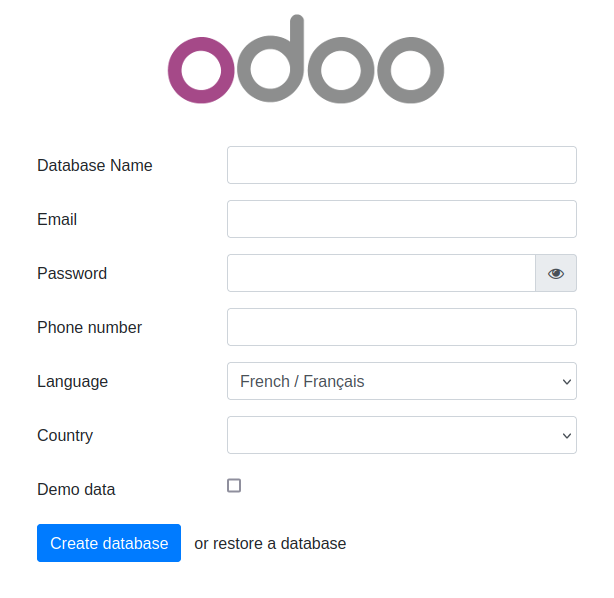
Open the final installation step at this web page :
http://[server IP]:8069/web/database/manager
-
Finish the installation by providing a database name, email and password. then click on Create Database. Depending on your system resources this may take more than 2 minutes without feedback ! Check your browser loading indicator.
-
Next, the web page will reload itself, and you should see the Applications list in ERPLibre:
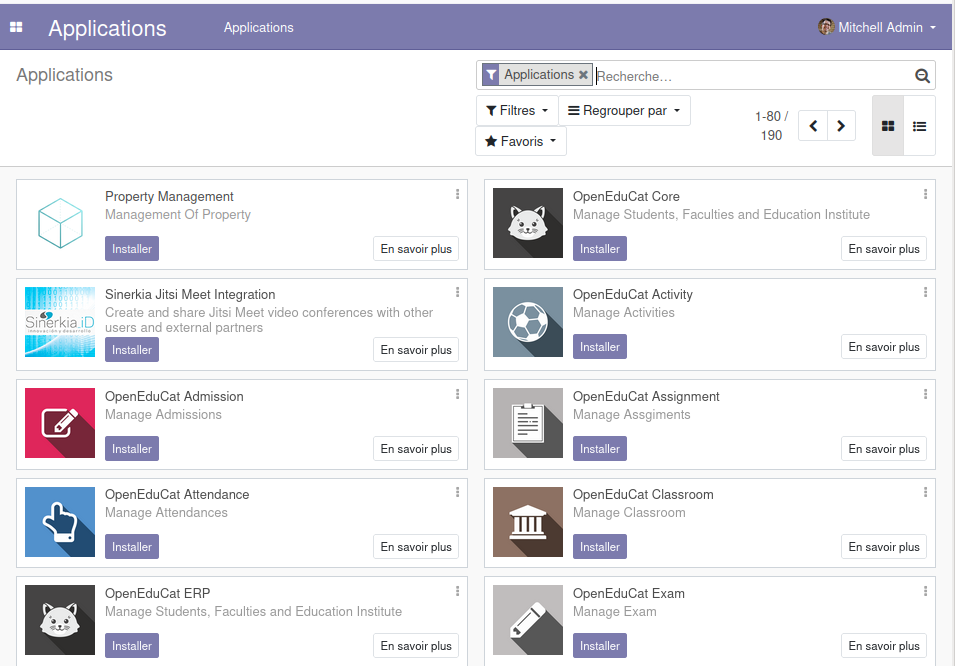
You can now personalize your ERPLibre installation.
For more information, read Docker guide.
Install from source code
Automated installation
For Debian/Ubuntu
sudo apt install make python3
Clone the project:
git clone https://github.com/ERPLibre/ERPLibre.git
cd ERPLibre
Follow the instruction on the following script, it will try to detect your environment.
make
Manually
Into Ubuntu, minimal dependency:
sudo apt install make git curl
Into Ubuntu, developer dependency:
sudo apt install make build-essential libssl-dev zlib1g-dev libreadline-dev libsqlite3-dev curl llvm libncurses5-dev libncursesw5-dev xz-utils tk-dev liblzma-dev libbz2-dev libldap2-dev libsasl2-dev
Clone the project:
git clone https://github.com/ERPLibre/ERPLibre.git
cd ERPLibre
make install_os detects the distribution and picks the right dependency script: apt for Ubuntu, Linux Mint and Debian, dnf for Fedora and the RHEL family, zypper for openSUSE, pacman for Arch. See the supported platforms above.
make install_os
make install_odoo_18
Install a specific Odoo version:
make install_odoo_16
make install_odoo_17
make install_odoo_18
Update your configuration if you need to run from another interface than 127.0.0.1, file config.conf
xmlrpc_interface = 0.0.0.0
Show version :
make version
Ready to execute:
make run
Test
Execute ERPLibre test with his code generator.
time make test_full_fast
Documentation
| Guide | Description |
|---|---|
| DISCOVER | Learn and explore ERPLibre |
| DEVELOPMENT | Development environment setup |
| PRODUCTION | Production server deployment |
| RUN | Execution modes and use cases |
| CODE_GENERATOR | Odoo module code generation |
| MIGRATION | Database migration between versions |
| GIT_REPO | Git repository management |
| POETRY | Python dependency management |
| FAQ | Frequently asked questions |
| HOWTO | How-to guides |
| WINDOWS_INSTALLATION | Windows installation |
Contributing
See CONTRIBUTION.md for guidelines.
License
This project is licensed under the GNU Affero General Public License v3.0.